
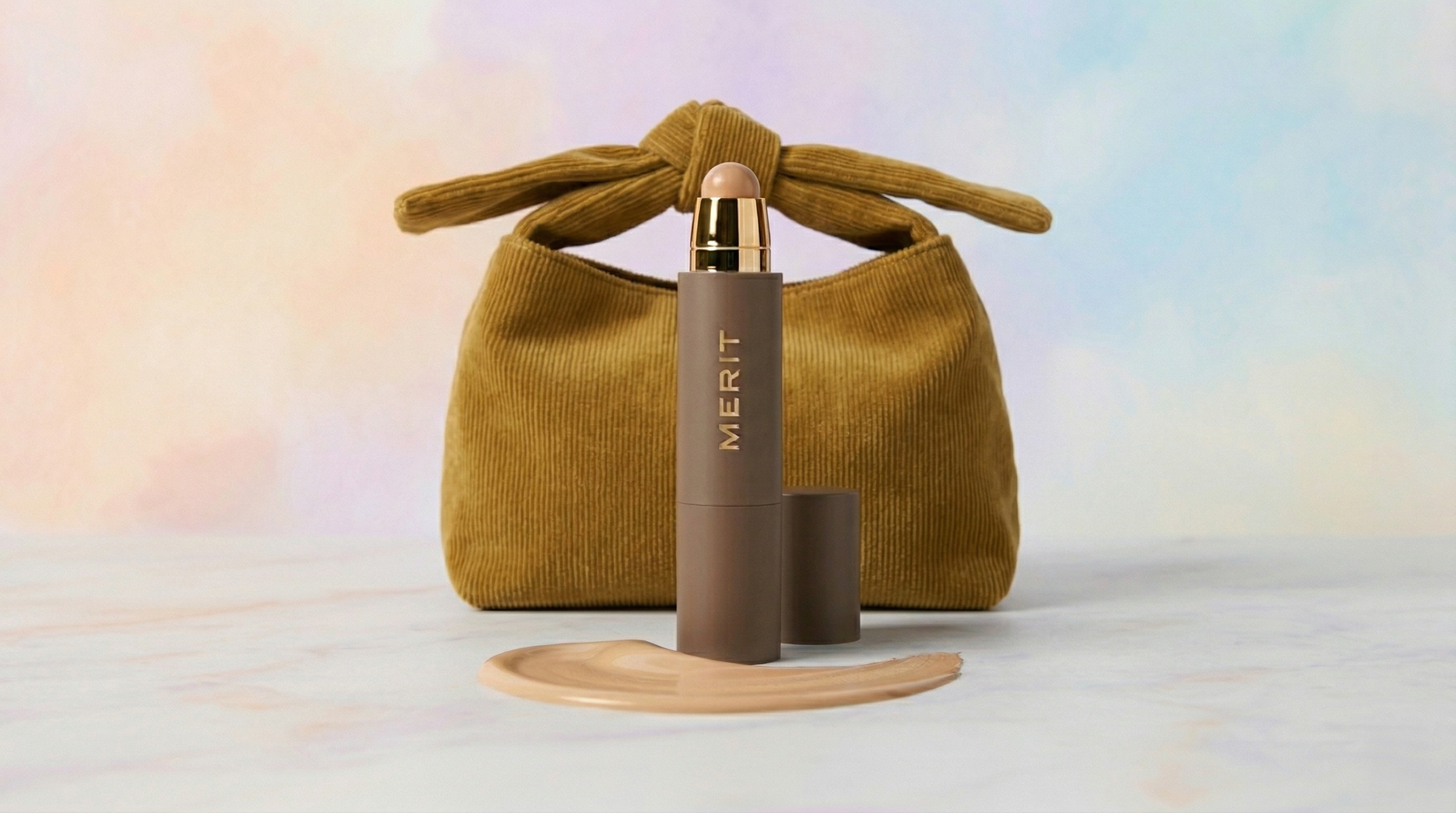
I don’t mean minimalism in one’s whole life. I mean minimalism in makeup. Most specifically, I am referring to a product from Merit Beauty called “The Minimalist” and Merit’s approach to minimalism.

Merit Beauty’s The Minimalist Complexion Stick
The Minimalist is a stick cream product which Merit describes as not being a foundation or concealer, but it can work as either and will replace both in your routine. It is vegan, cruelty-free, and they describe it as “clean.” Now, we know here in the lab that “clean” is just marketing jargon with no actual definition, except the one the company gives it. Other claims include:
- Lightweight, buildable formula for natural-looking coverage
- Clinically proven to wear comfortably all day
- Visibly blurs imperfections and evens skin tone
- Can be applied all over for full coverage or used to make small edits
- Transfer, sweat, and humidity-resistant
- Non-comedogenic and safe for sensitive skin
- Dermatologist-tested


Infographics taken from Merit Beauty’s webpage promoting The Minimalist

The Minimalist Complexion Stick’s 30 Shades
The Minimalist comes in 30 different shades. For my skin tone, I was recommended the colour “Dune” by Findation.com. If you’ve never used Findation.com, you have to try it. It’s free to use; you just plug in your existing shade matches, and AI will figure out your shade matches in a bunch of other products. You can use a search feature to look up a specific product.

Findation.com’s Landing Page

On Minimalism… In Makeup
A mountain singularly in the picture represents minimalism
Merit’s approach to minimalism is essentially a “less-is-more” payload strategy designed for the professional and mature consumer who wants to bypass the saturated, 15-step marketing cycle. By compressing an entire routine into roughly seven core units, they’ve optimized for time efficiency and kit decluttering. These strategies pair well with a natural, no-makeup look that I like to wear as a guy; less product tends to pay off.
The Merit Beauty Minimalism Audit
- The “Clean” Marketing Variable: From a technical lab perspective, it is critical to note that the term “clean” is unregulated marketing jargon with no standardized industry definition. While Merit adheres to an internal “no-list” and EU-compliant standards, the term serves as a branding layer rather than a verified scientific metric. In this lab, we treat “clean” as a preference rather than a performance specification.
- Multi-Functional Hardware: Merit specializes in hybrid units. Their star component, The Minimalist Complexion Stick, is engineered to replace both foundation and concealer in a single, mess-free payload. It’s designed for high-efficiency deployment on the go, prioritizing ease of use over complex layering.
- Formula Payload: The brand focuses on a “low-intervention” finish. Their formulas are designed to provide a skin-like texture that masks minor imperfections without the heavy pigment load of traditional full-coverage products. It’s an audit of restraint rather than excess.
- Architectural Packaging: Their hardware geometry is inspired by fashion and everyday objects rather than typical beauty tropes. The aesthetic is sleek and high-quality, aiming for a “responsible luxury” feel that targets Millennials and Gen X rather than chasing youth-coded trends.
Merit isn’t trying to be the loudest brand in the lab; it’s trying to be the clearest. They have effectively mapped out a routine that maximizes portability and streamlines the application process. If you’re looking to strip your station down to the essential hardware, Merit’s minimalist matrix provides a solid blueprint—just don’t let the “clean” jargon distract you from the actual formula performance.
Now let’s talk about the product itself. As I stated earlier, The Minimalist Complexion Stick is a stick product that Merit describes as neither a foundation nor a concealer, but it claims it will replace both. In reality, the product is a creamy multi-stick in different skin shades. I think it’s fair to call it a foundation or concealer, or perhaps a foundcealer.

Cabbie’s avatar applying The Minimalist Complexion Stick to his face
I have found that I have been reaching for this product more and more. I have never used a stick foundation or concealer before, so this format is completely new to me. I enjoy how easy the product is to use. I typically draw a line on my forehead, a line on my nose, a dot over any blemishes and then some on any red areas. I tap and buff it into my skin with a Sigma F80 Flat Kabuki Brush, which, as an aside, is an excellent brush for applying foundation. I suppose I end up covering my whole face with The Minimalist by the time I am done, but you don’t have to use it like that. It can be used as a concealer on the areas you need to “edit”; then a quick buff and tap with the F80, and you’re good to go. Finally, I apply setting powder to my face to lock the makeup in, even though it claims to be transfer-resistant on its own. The nice thing about The Minimalist is that it allows enough colour to peek through the product that I don’t have to add colour back to my face to make myself look alive. So, if you’re a guy like me, it’s a bonus! I don’t have to worry about carefully applying blush to bring back some colour. The stick is also forgiving, like all of Merit’s products. If you apply too much, it’s easy enough to buff it out. Down the list, but it should be at the top, is how comfortable wearing The Minimalist is. If you’ve tried this foundcealer, or however you wish to classify it, drop me a note and let me know what you love about it and if you experience any pain points with it, below.
I plan to do a wear test and answer the following questions…
Stick Foundation Technical Audit Template
I. Hardware Audit
- Mechanism Resistance (Twist-up/down): Evaluates the smoothness of the internal tracks and whether the stick retracts without sticking.
- Bullet Stability (Rattle or Lean Factor): Indicates whether the foundation stick is securely anchored or wobbles, which can lead to structural snapping.
- Component Geometry & Cap Seal Security: Analyzes the physical shape for grip and the cap’s “clicks” to prevent formula dehydration.
- Housing Integrity (Durability of Case): A stress test of the external materials to ensure they won’t crack or dent in a professional kit.
- Portability & Travel-Ready Rating: A score based on weight-to-size ratio and the likelihood of the cap staying secure during transit.
II. Formula Audit
- Pigment Payload & Opacity: The concentration of pigment in the wax matrix and whether it achieves full coverage in a single deployment.
- Surface Tension (Glide vs. Tug): Measures the friction during application; a technical fail involves “dragging” the skin.
- Thermal Reactive Point (Melting on Contact): How quickly the solid formula transitions to a blendable state once it hits skin temperature.
- Pore & Texture Masking Efficiency: The formula’s ability to “float” over texture rather than sinking into and highlighting pores.
- Finish Type & Lustre Stability: Categorizes the final look (Matte, Satin, Dewy) and how long that specific finish remains unchanged.
III. Deployment & Sensory Audit
- Weightlessness Factor: A subjective but critical measure of how heavy or “waxy” the product feels on the skin barrier.
- Initial Set Time (Wet to Dry Interval): The window of time available for blending before the formula “locks” into place.
- Blendability (Brush/Sponge/Finger Compatibility): Testing the formula’s synergy with different tools to find the most efficient deployment method.
- Olfactory Profile (Scent & Persistence): Identification of any added fragrance and how many hours it remains detectable.
- Skin Barrier Feel (Hydration vs. Drag): Assessing if the skin feels flexible and hydrated or tight and restricted after the set.
IV. Stability & Wear Test (The Data)
- Hour 2, 4, 6, and 8 Benchmarks: Scheduled check-ins to document the evolution of the formula over a standard workday.
- Oil Breakthrough Analysis: Identifying the exact timestamp when natural sebum begins to compromise the finish.
- Oxidation Benchmarking (Pigment Shift): Monitoring the formula for any colour changes or “orange” shifts due to air exposure.
- Migration Resistance (Creasing in Fine Lines): Auditing “movement” into expression lines or around the nasal folds.
- Transfer Audit (Tissue/Glass Test): A physical test to see how much payload is lost when the face contacts external surfaces.
V. Decontamination & Value
- Solubility (Removal Difficulty): A rating of how easily the formula breaks down under standard lab cleansers (oils vs. waters).
- Residual Buildup Analysis (Pore Clogging): Checking for trapped pigment or texture left behind after a “clean station” removal.
- Payload Volume vs. Retail Price: A breakdown of the actual amount of product (grams/oz) provided relative to the MSRP.
VI. Final Audit Result
Lab Status: The ultimate verdict—Cabbie Approved or a total Skip.
Want to be notified when a new blog post is made? Sign up for Cabbie’s Makeup Corner’s mailing list by clicking the button below:


